

An MVP usually costs 10% to 30% of what a full product costs to build, and it can reach the market about 35% faster. That gap is the whole reason this question comes up so often. But cheaper and faster isn’t always better. The real question isn’t which one costs less. It’s which one actually fits where your startup is right now.
Here’s a plain look at what each option really means, what it costs, how long it takes, and how to tell which one is right for you.

What Each One Actually Means
An MVP, or minimum viable product, is the smallest working version of your idea that still solves a real problem for real users. It’s not a rough sketch and it’s not a demo. It’s a working product, just a narrow one, built to test whether people actually want what you’re offering.
A full product is the complete version. It covers more use cases, more user types, and more edge cases. It usually includes polish, advanced features, deeper integrations, and the kind of scale and reliability a mature business needs.
The Real Difference Is the Goal, Not the Size
It’s tempting to think of an MVP as just “a smaller full product.” That’s not quite right. An MVP is built to answer a question: will people actually use and pay for this? A full product is built to serve a market you already understand. One is about learning. The other is about scaling. Mixing up these two goals is where a lot of startups get into trouble.
Cost: Why the Gap Is So Large
An MVP typically runs in the range of $30,000 to $80,000 and takes a lean, focused team to build. A full product, by comparison, often costs $100,000 to $500,000 or more, since it needs more design work, more testing, more infrastructure, and a bigger team to pull it together. Some studies put total savings from starting with an MVP as high as 50% to 70% compared to building everything up front.
Timeline: How Long Each One Usually Takes
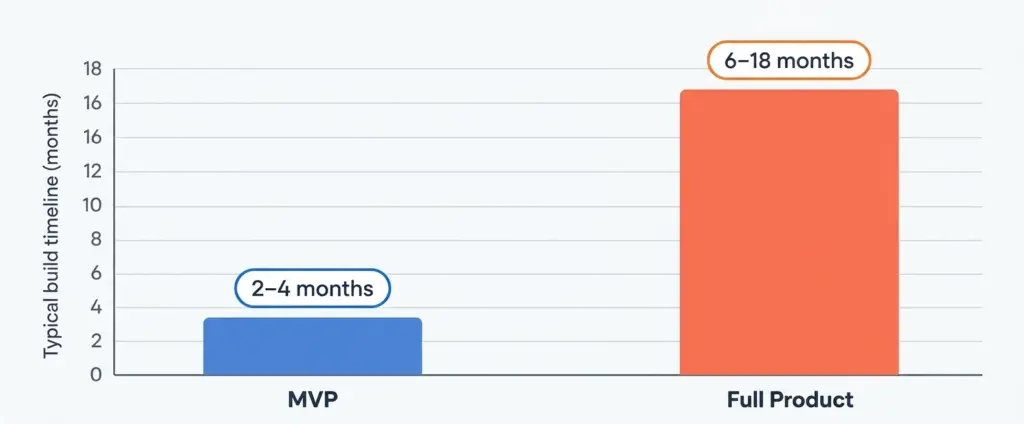
Speed is one of the clearest differences between the two paths. An MVP is built to move fast, while a full product takes the time it needs to be complete and dependable.
Risk: Why Skipping the MVP Stage Is Risky for Most Startups
About 42% of startups fail simply because they build something the market doesn’t actually want. A full product built before anyone has tested the core idea carries that risk at full size, with a full budget behind it. An MVP is built specifically to catch that problem early, while it’s still cheap to fix.
When a Full Product Makes More Sense
An MVP isn’t the right answer for every situation. A full product is usually the better first move in a few specific cases:
| Situation | Why a Full Product Fits |
| Regulated industries (fintech, healthtech) | Security, compliance, and legal requirements often have to be in place before a single user can log in |
| Demand is already proven | If you already have paying customers or a signed contract, there’s less left to validate |
| Funding is already secured | A well-funded team with a clear plan may not need to test on a shoestring budget first |
| The market expects completeness | Some categories (like enterprise software) are judged harshly for feeling unfinished |
What You Give Up With an MVP
An MVP isn’t free of trade-offs. It usually means fewer features, a narrower set of users it serves well, and sometimes less visual polish than a competitor’s finished product. An MVP should still look and feel professional; it just doesn’t need every feature or every detail a final product would have. Founders who understand this upfront tend to set expectations with early users correctly, which matters more than people expect.
How Startups Usually Move From One to the Other
Most successful products don’t stay MVPs forever. The usual path looks like this: launch the MVP, learn from real usage, fix what’s broken, and gradually add the features that real data says matter. The MVP doesn’t get thrown away and rebuilt from scratch; it gets built on, piece by piece, until it becomes the full product. That gradual path is usually far less risky than trying to build everything correctly on the first attempt.
Bringing It Together
The choice between an MVP and a full product isn’t about which one is “better.” It’s about matching the build to what you actually know right now. If you’re still testing whether people want what you’re building, an MVP is almost always the safer, cheaper, faster path. If you already have proof, funding, and a market that expects completeness, a full product may be the right call from day one.
At Digiratina, this is one of the first conversations we have with every founder, working out honestly which path fits your stage, not just which one sounds more impressive. If you’re weighing an MVP against a full build, we’re happy to talk it through with you.