
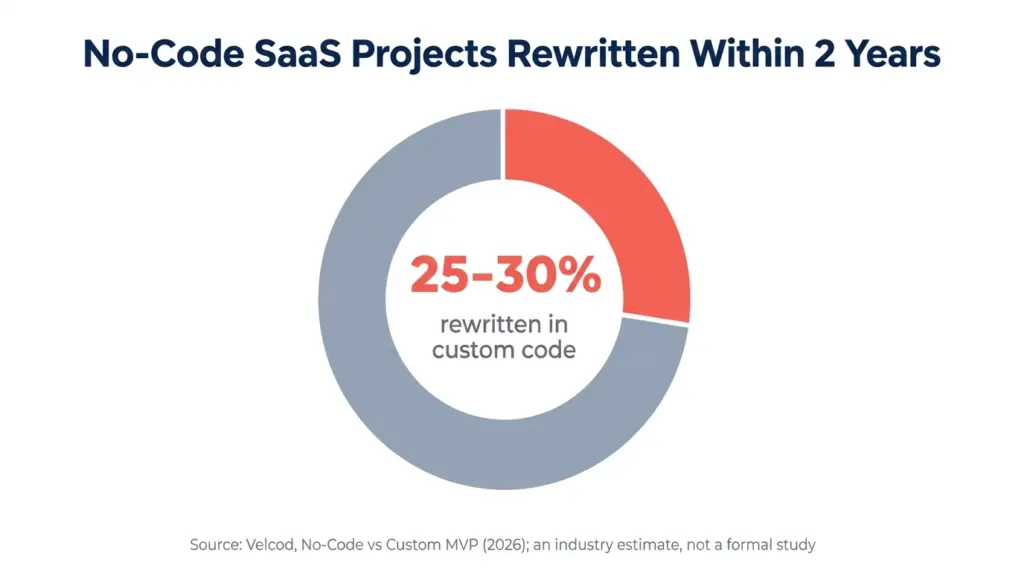
A no-code MVP can be live in 2 to 6 weeks. A custom-built one usually takes 10 to 14 weeks or more. That speed gap is why so many founders start with no-code. But there’s a catch. Industry estimates suggest that about 1 in 4 no-code SaaS projects end up being rewritten in custom code within two years.
So, which one should you pick? Neither is right for everyone. Here’s a detailed look at how they compare, so you can choose based on your situation, not on hype.
What Each One Actually Means
No-code means building your product with visual tools like Bubble, Webflow, or FlutterFlow. You drag, drop, and connect things instead of writing code. You don’t need to be a developer to use them.
Custom development means a developer or team writes the code from scratch, built around your exact needs. You get full control, but it takes more time and money to get started.
Speed: No Code Wins the First Race
If your main goal is to get something in front of real users quickly, no code is hard to beat. A simple no code MVP can go live in 2 to 6 weeks. A lean custom MVP usually takes 10 to 14 weeks, and a fuller custom build can take 4 to 6 months. When you’re still testing whether anyone wants your idea, those extra weeks matter.
Cost: A Big Gap Up Front
The upfront price difference is large. A no-code MVP can cost as little as a few thousand dollars, while a custom build usually starts well above that. Estimates vary quite a bit between sources, so treat these numbers as ballparks, not quotes.
Ownership: Renting vs Owning
With no-code, you’re building someone else’s platform. You can’t take the underlying code with you, and the platform can change its pricing or features at any time. With custom development, you own every line of code. That matters a lot if you plan to raise funding or sell the company one day, since some investors look closely at who owns the technology.
Scaling: Where No-Code Starts to Struggle
No-code tools work well for small user bases. As your product grows, you may start to hit limits on speed, data, and custom features. This is the main reason some teams eventually move to custom code. Rebuilding later isn’t cheap either. Some sources estimate that rewriting a complex no-code app can cost 50% to 100% of what building it in custom code from the start would cost.
Which One Fits Your Situation?
| Choose No-Code If… | Choose Custom If… |
| Your budget is small | You have a validated idea and clear requirements |
| You need to launch in a few weeks | You expect a large number of users soon |
| You’re still testing an unproven idea | Your product relies on complex logic or AI features |
| You’re building an internal tool or simple workflow | You need a polished native mobile app |
| You’re a non-technical founder who wants to iterate on your own | You’re in a regulated field like fintech or healthtech, or raising venture funding |
The Middle Path Many Startups Take
It doesn’t have to be one or the other. A common approach is to start with no-code to prove people want your product, then move to custom code once you have real users and revenue. Some founders even use the money from their no-code customers to fund the custom build. There’s also a newer in-between option: custom code built with AI-assisted tools, which can bring the cost of a lean custom MVP down closer to the no-code range.
The key is to plan the move early. If you know you may outgrow your no-code platform, keep your data clean, document your workflows, and avoid building around quirks of the tool. That makes a later switch far less painful.
Bringing It Together
No-code is the fastest, cheaper way to test an idea. Custom is the stronger foundation for a product you expect to grow. The right choice depends on how much you already know about your market, how much money and time you have, and how big you expect to get. If you’re still unsure people want what you’re building, start small. If you already have proof, build it for the long run.
At Digiratina, we help founders work out which path fits their stage, and we’re happy to build the MVP either way. If you’re weighing no-code against custom for your own product, we’re glad to talk it through with you.
Contact our experts today!