


At some point, almost every founder asks the same question: should I hire a local team or work with developers overseas? The lower cost of offshore development can be attractive, but cost isn’t the only thing to consider.
The real difference comes down to communication, time zones, project management, and how closely you want to work with your development team. Before choosing, consider both the cost and the level of support and involvement you’ll need throughout the project.
Neither option is automatically right. A local agency can be worth every extra dollar for one founder, and completely unnecessary for another. The goal here isn’t to declare a winner. It’s to help you see the actual tradeoffs clearly, so you can pick up the option that fits your product, your budget, and how hands you plan to be.
1. The Cost Gap Is Real, and It’s Large
Offshore advantage
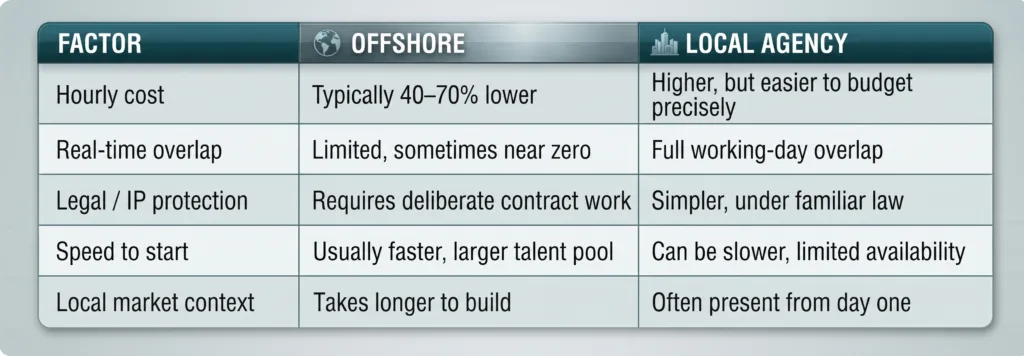
This is the reason the offshore conversation happens in the first place. Developer rates vary enormously by region, often by 3-5 times for comparable experience levels. For a cash constrained early-stage startup, that gap can be the difference between affording a proper MVP and not affording one at all.
2. Real-Time Collaboration Gets Harder the Farther You Go
Local advantage
A lower rate doesn’t mean much if every question takes a full day to get answered. Time zone overlap is one of the most underestimated factors in this decision. A local agency shares your working hours entirely. A nearshore team in Latin America usually overlaps for several hours a day. A fully offshore team on the other side of the world might only overlap for an hour, or not at all, which means decisions that should take minutes to end up taking a full day.

3. Local Agencies Usually Offer Stronger Legal and IP Protection
Local advantage
Contracts with a local agency are easier to enforce, because they sit under laws and courts you already understand. Offshore contracts can still be solid, but protecting your intellectual property across borders takes more deliberate legal work to clear IP-assignment clauses, signed NDAs, and sometimes local legal counsel in the country you’re hiring from. This isn’t a reason to avoid offshore hiring, but it is a real cost, in time and legal fees, that’s easy to underestimate.
4. Offshore Teams Often Move Faster to Get Started
Offshore advantage
Local agencies, especially good ones, often have limited availability and can book out weeks or months in advance. Offshore markets are larger and more distributed, so it’s often easier to find a qualified team ready to start soon. If speed to kickoff matters more than anything else, offshore or nearshore options widen your options considerably.
5. Communication Style and Context Take Longer to Build Remotely
Local advantage
This one is subtle but real. A local team picks up on unstated context faster, how your market works, what your users expect, the small cultural cues in your product. An offshore team can absolutely get there too, but it usually takes more deliberate onboarding, clearer written documentation, and a bit more patience early on. If your product depends heavily on local nuance, a hyper-local marketplace, for example, that ramp up time is worth planning for.
6. Nearshore Is Often the Middle Ground Founders Actually Want
Worth considering
Before ruling offshore out entirely, it’s worth looking at nearshore options, teams in a similar time zone, even if they’re not local. For US startups, that often means Latin America. You still get meaningfully lower rates than local hiring, but with several hours of real-time overlap each day, which removes a lot of the friction that makes fully offshore engagements harder to manage.
7. Quality Variance Exists on Both Sides
Worth considering
It’s tempting to assume “local means better quality” or “offshore means cheaper but riskier.” Neither is true. There are excellent offshore teams and mediocre local ones, and the reverse is just as common. What predicts quality is the same regardless of location: a real discovery process, transparent communication, and a track record of comparable projects. Location tells you about logistics, not competence.
The Decision Usually Comes Down to Three Questions
Once you strip away the general pros and cons, the choice usually rests on how you’d answer three questions honestly.
How tight is your budget, really?
How much real-time collaboration does your product’s complexity demand?
And how comfortable are you managing a team you may never meet in person?
A founder with a tight budget, a standard product, and comfort with async communication is often well served offshore or nearshore. A founder building something regulation-heavy, requirement fuzzy, or deeply dependent on local nuance often gets more value from paying more for a local team.
Bringing It Together
Offshore and local MVP development aren’t competing with philosophies; they’re different tools for different situations. Offshore buys you cost savings and often faster access to talent, at the price of a smaller collaboration window and more deliberate legal groundwork. Local buys you tighter real time collaboration and simpler legal protection, at a higher rate. Nearshore sits in between and deserves more consideration than it usually gets.
At Digiratina, we work with founders across all three models and help them think through which one fits their product, not just their budget. If you’re weighing offshore against locals for your own MVP, we’re happy to walk through the trade-offs with you directly. Consult with our industry experts today!