


Both a vendor and a partner can build your software. On the first sales call, they can even look and sound the same. The real difference shows up later, when something breaks, when the plan changes, or when launch day has passed and you still need help.
That’s why founders are often told to test for the difference before signing anything. Here is a plain look at how a vendor and a partner really differ, how to spot each one early, and when a vendor is actually the right choice.

The Short Answer
A vendor delivers what you specified, for an agreed price, and moves on. A partner shares responsibility for the outcome. In other words, a vendor asks what needs to be built. A partner also asks why.
The Differences at a Glance
| Area | Vendor | Partner |
| Main focus | Delivering the agreed scope | Reaching your wider business goal |
| Approach | Asks what to build | Asks why it needs to be built |
| Requirements | Follows them as written | Questions unclear ones and suggests better options |
| Future needs | Focuses on the current project | Thinks about scaling, security, and maintenance |
| Relationship | Usually project-by-project | Often grows into a long-term working relationship |
| Best for | Clear, well-defined projects | Complex products and long-term growth |
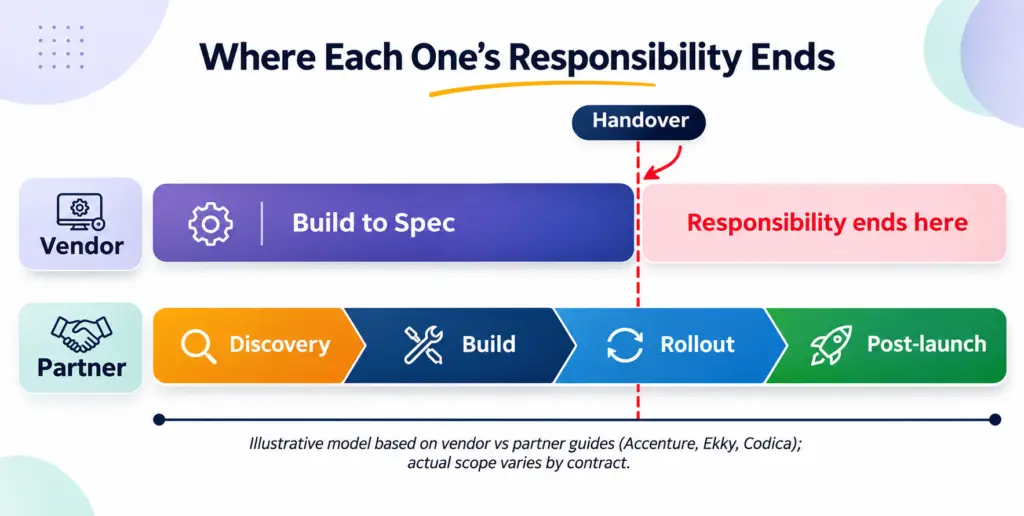
Where Responsibility Ends
The clearest difference is what happens after the code is delivered. A vendor’s job usually ends at handover. A partner usually stays through rollout and keeps helping until your team is actually using the product without trouble.
Why You Often Notice It Too Late
During the sales process, almost every team looks like a partner. They are friendly, keen, and quick to say yes. The difference tends to show up months in. When something breaks, a partner owns the problem. A vendor may simply bill for the fix.
That is why the smartest time to test is before you sign, while you still have the most say. Features and price alone don’t tell you how a team will behave on day 91.
How to Spot a Partner Early
- They ask about your users first. A good team wants to understand your business model and your customers before they talk about timelines and pricing.
- They push back. If a request doesn’t make sense for your users or your tech, a partner says so, even when saying yes would be easier.
- They explain trade-offs plainly. A partner answers hard questions directly. A vendor tends to hedge.
- They plan for after launch. They can tell you what happens the week after go-live, and what support looks like.
Red Flags That You’re Dealing With a Vendor
- They jump straight to price and delivery dates without asking about your goals.
- They agree to everything and never challenge a request.
- They promise fast delivery but give no detail on how.
- They are vague about support after launch.
- They try to lock you into their own hosting or hold back your code until the final payment.
When a Vendor Is Actually Enough
A partner isn’t always the better choice. If the work is completely known, a vendor can be the right fit. That means you already have a strict specification, a clear design, and a clear idea of what “done” looks like. In that case, you mostly need hands to build it, and a vendor relationship keeps things simple.
When a Partner Is the Wrong Choice
On the other hand, don’t hire a partner too early. If you haven’t validated that people want your product, paying an agency to build custom software is premature. You’d be paying for strategy you may not be ready to use. Test the idea first, then bring in a partner to build it.
| Choose a Vendor When… | Choose a Partner When… |
| The work is fully defined | The product is central to your business |
| You have a detailed spec and clear design | You need help shaping what to build |
| It’s a one-off project | You expect ongoing work and growth |
| You can manage the project yourself | You don’t have an in-house product team |
Five Questions to Test a Team Before You Sign
- What do you need to know about my users before you start?
- If my plan has a flaw, will you tell me?
- If something breaks after launch, who owns the problem?
- What happens in the week after we go live?
- Who owns the source code and the hosting?
Listen to how they answer, not just what they say. A partner answers plainly. A vendor tends to deflect or promise everything.
Bringing It Together
A vendor builds what you hand them. A partner helps decide what to build, stays accountable for how it turns out, and keeps going after launch. Neither is wrong. A vendor suits a clear, one-off job. A partner suits a product you want to grow. The trick is to know which one you need, and to test for it before you sign.
At Digiratina, we aim to work as a partner from the first conversation, starting with your users and your goals rather than a price. If you’re comparing teams for your next product, we’re happy to talk it through with you.