


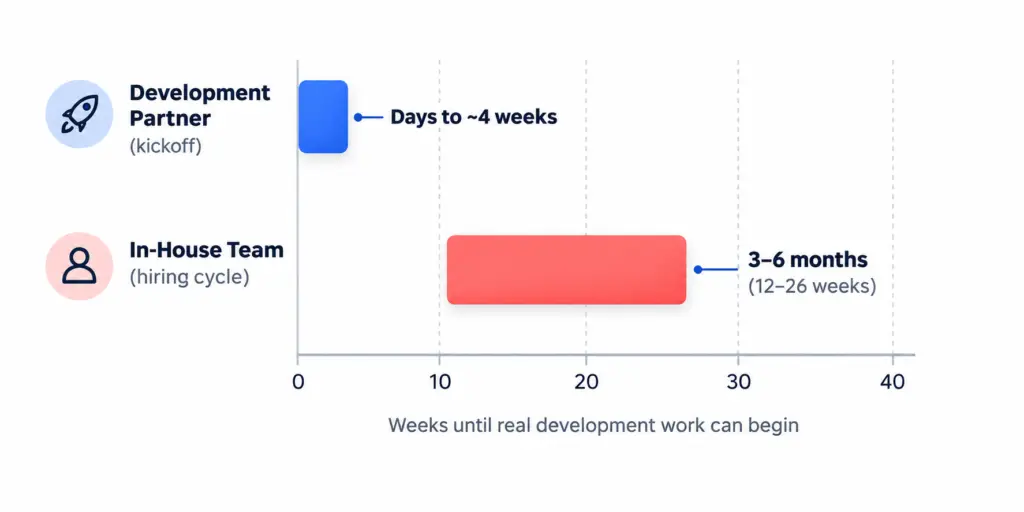
Hiring an in-house development team can take three to six months. A development partner can often start in a few days or weeks. That gap is why so many founders ask the same question: when is the right time to hire a software development partner?
Too early, and you may pay a team to build the wrong thing. Too late, and you lose months you can’t get back. Here are the clear signs it’s time, the signs it isn’t, and how to move from a partner to your own team later.

1. You’ve Validated the Idea
This is the clearest sign. You’ve talked to real users, you know the problem is real, and you know what the core feature should be. At this point, the main thing missing is people to build it. A partner can turn a validated idea into a working MVP while you stay focused on customers and growth.
2. Speed Matters More Than Anything Else
If you have a deadline, such as a pilot, a demo day, or a funding round, waiting months to hire is rarely an option. A good partner already has a team, a process, and tools in place. That means you can skip the long hiring cycle and start building almost right away.
3. Nobody on Your Team Has the Skills You Need
Some projects need skills that are hard to hire for: mobile apps, AI features, payments, or compliance in a regulated industry. Hiring one specialist for each of these is slow and expensive. A partner often brings several of these skills together in one team, so you don’t have to find each person separately.
4. You Don’t Have Technical Leadership
Many non-technical founders worry about managing engineers they can’t fully judge. A partner can take on that burden. They bring their own technical leads and review processes, such as code reviews and testing, so quality risk doesn’t sit entirely on your shoulders.
5. You Need Extra Hands While You Hire
A partner doesn’t have to replace your team. Many startups use one to build in parallel while they recruit. Your first in-house hires can then join a product that is already moving, instead of starting from a blank page.
6. Waiting Now Costs More Than Hiring Help
Ask yourself what delay is costing you. Manual processes, lost customers, and missed windows all add up. When the cost of not building is bigger than the cost of a partner, it’s time.
7. When It’s Too Early
A partner isn’t the right move for every business at every stage. Sometimes, the smartest decision is to take a step back, validate your ideas, and get a few things in place before bringing a development team on board. Hold off if:
You’re still figuring out if the problem is real.
If you don’t yet know what the core feature should be, bringing in a team will only speed up building the wrong thing. Do user research first.
You haven’t budgeted for after launch.
Software needs fixes, updates, and new features once it’s live. If your budget stops at launch day, plan for the next phase before you start.
And don’t choose a partner only because their quote is the lowest. A cheap quote that leads to rework usually costs more in the end.
8. Look for a Partner, Not Just a Vendor
Once you decide to hire help, the kind of team matters as much as the timing. A vendor does what the spec says. A partner thinks about your goals.
| Vendor | Partner |
| Delivers tasks from a spec | Challenges specs that hide risk |
| Focuses on billable hours | Focuses on learning quickly from users |
| Hands over code and moves on | Leaves you with systems you can run |
| Avoids product opinions | Connects engineering to your user goals |
If every request gets a “yes” and nobody pushes back, you may have hired a vendor.
Planning the Move to an In-House Team
Most startups don’t stay with a partner forever. A common path is partner first, then a mix of partner and first hires, then an in-house team as the product grows.
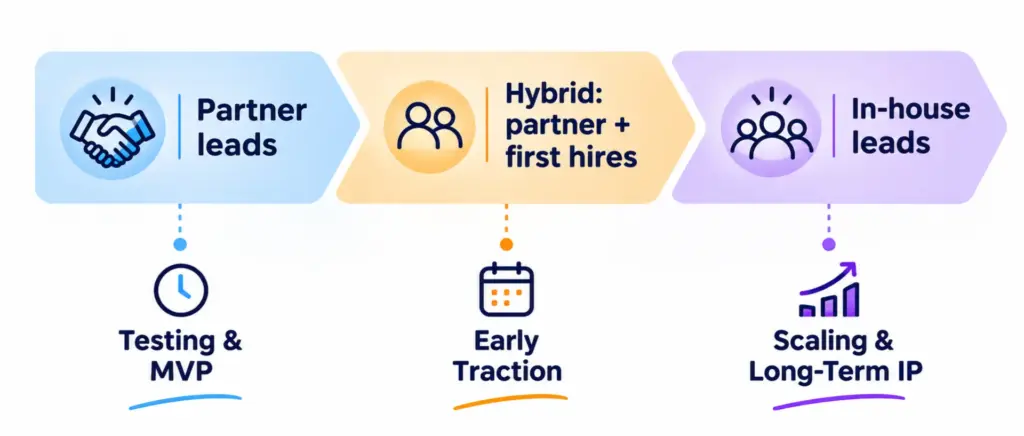
Good signs it’s time to bring development in-house include having steady engineering work and the budget to pay a team, and finding that your partner’s capacity, not your decisions, is what slows you down. To make the handover smooth, ask your partner from day one to document the architecture and working conventions, so new hires can be productive in weeks, not months.
Bringing It Together
The right time to hire a software development partner is when you have a validated idea, a need for speed, and a gap in skills or leadership you can’t fill quickly. Hire too early and you risk building the wrong thing. Wait too long and you lose time you won’t get back. Pick up a partner who pushes back and plans for the handover, and you’ll have a team that fits both today and tomorrow.
At Digiratina, we start every engagement by checking whether you’re ready, because the best partnership begins with an honest answer. If you’re deciding whether now is the right time, we’re happy to talk it through with you.