
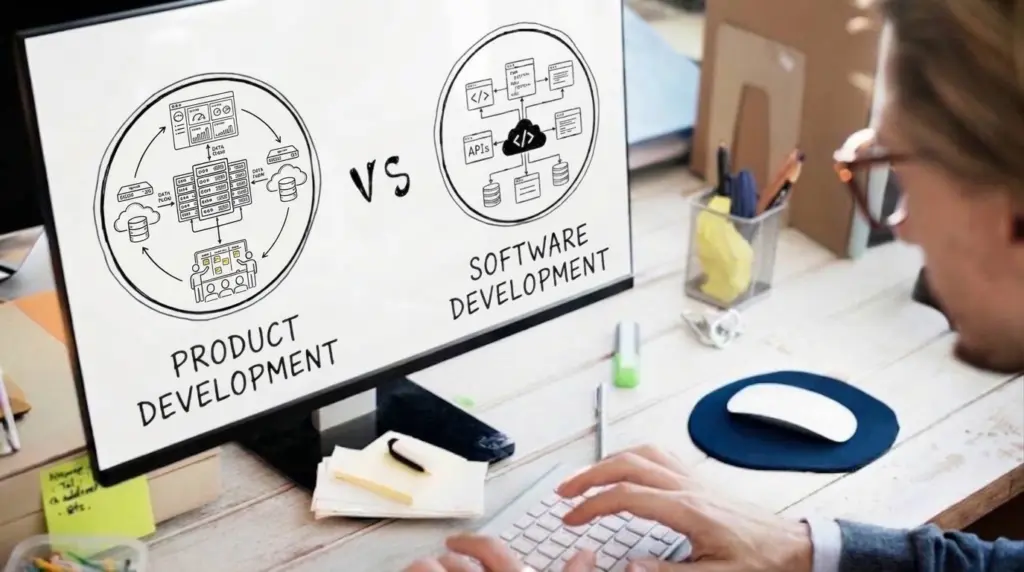
In an increasingly technology-driven business environment, organisations must distinguish between developing a successful product and engineering the software that enables its functionality. Although closely connected, product development and software development serve different strategic and operational purposes. Product development encompasses market research, customer requirements, product strategy, design, commercialisation, and lifecycle management. Software development focuses on designing, building, testing, deploying, and maintaining digital applications and systems. Understanding these distinctions is essential for businesses investing in digital products, enterprise platforms, and technology-enabled services. A clear understanding of both disciplines enables organisations to allocate resources effectively, coordinate multidisciplinary teams, and ensure that technical investments support defined business objectives.
What Is Product Development?
Product development is the comprehensive process of transforming a business opportunity or customer requirement into a market-ready offering. It involves identifying market opportunities, establishing a value proposition, evaluating customer needs, designing solutions, and managing product performance throughout its lifecycle.
The discipline incorporates business strategy, market research, product management, user experience, engineering, marketing, and commercialisation. Its principal objective is to ensure that a product addresses genuine customer requirements and delivers sustainable business value.
According to IBM, product development involves creating and launching products that meet customer needs, supported by strategic planning, engineering, and continuous improvement.
For digital businesses, this includes defining product requirements, establishing roadmaps, prioritising features, and evaluating market suitability.
What Is Software Development?
Software development is the technical process of designing, building, testing, deploying, and maintaining applications, platforms, and information systems. It transforms defined requirements into functional digital solutions through programming, architecture, database engineering, integration, and testing.
The Software Development Life Cycle (SDLC) provides a structured framework covering planning, requirements analysis, design, development, testing, deployment, and maintenance.
Its primary considerations include functionality, performance, security, scalability, reliability, and maintainability.
Typical software development activities include:
- Frontend and backend application development.
- Database architecture and API integration.
- Web and mobile application engineering.
- Cloud infrastructure and deployment.
- Software testing and quality assurance.
- Security implementation and maintenance.
- Performance optimization and system enhancements.
Software development supports commercial products, enterprise platforms, internal business systems, and application modernisation initiatives.
Product Development vs Software Development: Key Differences
| Evaluation area | Product development | Software development |
| Primary objective | Deliver a viable product | Build functional software |
| Main focus | Customer requirements and business value | Technical implementation |
| Initial activities | Market research and product strategy | Requirements and technical planning |
| Responsibilities | Discovery, design, prioritisation and commercialisation | Architecture, coding, testing and deployment |
| Deliverables | Product roadmap, prototypes and market-ready offerings | Applications, source code and releases |
| Success measures | Adoption, retention and commercial performance | Reliability, security and performance |
| Long-term focus | Product evolution | Maintenance and technical enhancement |
Product development establishes the strategic direction and commercial proposition, while software development provides the engineering capabilities required to realise them.
Differences in Strategic Objectives
Product development begins with market and business considerations. It examines customer expectations, competitive positioning, market opportunities, and commercial potential. Decisions are evaluated according to their contribution to customer value and organisational objectives.
Software development focuses on technical execution. Engineering decisions are influenced by architecture, functionality, infrastructure, security requirements, and available technical resources.
For example, developing an online financial management platform requires identifying the target market, customer problems, essential features, and commercial proposition. These activities fall within product development. Database design, authentication, financial calculations, payment integrations, and security testing constitute software development.
Both disciplines must remain aligned to ensure that technical implementation supports the intended business outcomes.
Differences in Processes and Methodologies
Product development follows an iterative process involving research, discovery, planning, design, validation, engineering, launch, and continuous improvement. Teams assess market opportunities, define requirements, prioritise features, develop prototypes, and evaluate technical feasibility before commercial introduction.
Software development follows a technically focused lifecycle involving requirements analysis, system architecture, programming, testing, deployment, and maintenance.
Agile methodologies support both disciplines through incremental delivery, continuous feedback, and collaborative planning. Product teams use these practices to validate assumptions and refine priorities, while engineering teams apply them to implement functionality and improve technical delivery.
Atlassian’s product development framework highlights the relationship between discovery, prioritisation, delivery, and post-launch learning.
Differences in Team Structures and Responsibilities
Product development requires multidisciplinary collaboration across business strategy, research, design, technology, and commercial functions.
Product managers establish product direction and priorities. Business analysts translate organisational requirements into specifications, while UX/UI designers develop user experiences. Marketing and sales professionals contribute market positioning and commercial planning.
Software development teams concentrate on engineering execution. Their responsibilities include solution architecture, frontend and backend programming, database management, DevOps, cybersecurity, quality assurance, and application maintenance.
Clear responsibilities and effective collaboration ensure that product requirements are accurately translated into technical solutions.
Differences in Performance Measurement
The disciplines require different performance indicators.
Product development is assessed through customer and commercial outcomes, including adoption, retention, conversion, satisfaction, revenue contribution, and product-market fit.
Software development is evaluated through technical and operational measures such as application availability, defect rates, deployment frequency, performance, security, and recovery capability.
Google’s DevOps Research and Assessment (DORA) framework examines software delivery performance and reliability, reinforcing the importance of measurable engineering outcomes and customer feedback.
These indicators should be evaluated together to establish whether the software performs effectively and whether the resulting product delivers meaningful business value.
How Product Development and Software Development Work Together
Consider an organization introducing a digital healthcare management platform.
Product development establishes the target audience, examines healthcare workflows, evaluates competing solutions, defines the product proposition, and identifies essential capabilities.
Software development translates these requirements into a functioning platform through patient record management, appointment scheduling, authentication, database architecture, application interfaces, and system integrations.
Following deployment, customer feedback and application performance inform future product decisions. Engineering teams then implement approved enhancements through additional development and testing.
This relationship continues throughout the product lifecycle, ensuring that technical improvements remain aligned with evolving customer and business requirements.
Choosing the Right Development Approach for Your Business
The appropriate approach depends on business objectives, technical requirements, and organisational capabilities.
Businesses introducing new digital products require a comprehensive product development strategy supported by software engineering. Organisations implementing internal management systems may primarily require software development aligned with established operational requirements.
For startups, product discovery and validation determine which capabilities deserve investment, while software development transforms prioritised requirements into functional applications. Established enterprises may require both disciplines when modernising legacy systems, expanding digital services, or introducing new technology products.
IBM’s product engineering framework further demonstrates how engineering connects technical execution with product quality, performance, and business strategy.
Conclusion
Product development and software development are distinct yet interdependent disciplines within modern technology organisations. Product development establishes strategic direction, market relevance, customer value, and commercial objectives. Software development provides the engineering expertise and technical processes required to build, operate, and maintain digital solutions. Successful digital initiatives require both disciplines to operate within a shared framework of technical governance, accountability, and continuous improvement. Recognising this relationship enables businesses to manage complexity, strengthen engineering performance, and maintain alignment between customer expectations and technology delivery.
At Digiratina Technology Solutions, we integrate product strategy, engineering expertise, and structured development practices to support organisations throughout the digital product lifecycle. Our capabilities encompass product discovery, MVP development, UI/UX design, custom software engineering, web and mobile applications, artificial intelligence, data solutions, and quality assurance. We help businesses translate commercial requirements into dependable technology solutions, with particular attention to scalability, security, maintainability, and long-term product objectives. Our commitment is to deliver sustainable engineering outcomes that advance business priorities and support long-term digital innovation.